
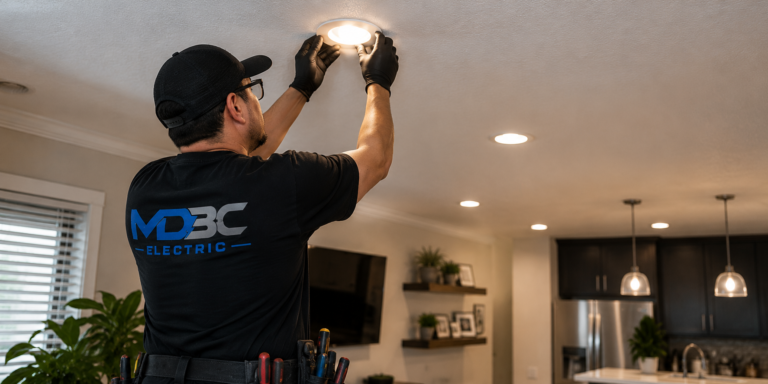
Lighting is one of the highest-impact upgrades you can make — it changes how a room feels and how much energy you use to light it. Here’s a practical tour of options for homes in Ventura and Santa Barbara counties. MDBC Electric (CSLB #1158234) handles layout, circuits, and fixture installs.
Types of Lighting
- Recessed (can) lighting — clean, built-in ceiling lights for even, modern illumination
- Under-cabinet & accent — task lighting for kitchens and display lighting for features
- Pendants & chandeliers — statement fixtures for kitchens, dining, and entryways
- Landscape & security — pathway, uplighting, and motion-sensor lighting for safety and curb appeal
Ceiling fans with light kits and replacement of builder-grade fixtures are everyday jobs too. See lighting installation & LED upgrades and ceiling fans & fixtures.
Why Switch to LED
LED lamps use far less energy than incandescent and last much longer. They also run cooler, which is easier on fixtures and on attic cans. Converting existing fixtures to LED is often the fastest lighting improvement: swap listed lamps or retrofits, keep the same boxes, add dimmers that are actually rated for LED.
We do not invent a bill-savings percentage for your house. Usage depends on hours on, old lamp type, and rates. What we can say: LEDs are the default for new work, and most clients replace remaining halogens and incandescents while we are already on site.
What a Lighting Project Involves
Depending on the scope, a project can mean adding new circuits, cutting in recessed housings, running wiring for new fixtures, and installing switches or dimmers. We plan the layout first so the finished result is even, balanced, and exactly where you want it.
New recessed lighting in a finished ceiling is more than “swap a globe.” Insulation-contact (IC) rated and airtight housings matter in California energy rules. We confirm joist direction, insulation, and whether we can work from the attic. Older wiring may need attention first — home rewiring 101.
Planning Your Lighting
Great lighting uses layers — ambient (overall), task (where you work), and accent (highlights). Add dimmers for flexibility, and choose a color temperature that fits the room: warmer tones for living spaces, cooler and brighter for kitchens, laundry, and garages.
Color temperature is measured in kelvin. Rough household ranges: about 2700K–3000K for living rooms and bedrooms; 3000K–3500K for kitchens and baths; 4000K+ for garages and workshops. Match lamps in the same sightline so one room is not mixed yellow and blue.
Kitchens, baths, and work areas
Kitchens usually need more than a single ceiling flush-mount: recessed or a central fixture for ambient light, under-cabinet for counters, and pendants where you want them over an island. Baths need damp- or wet-rated fixtures, and GFCI-protected circuits near water. See GFCI & electrical safety and outlets & switches.
Closets have clearance rules for fixture types. We will not put a bare lamp against a shelf just because the old one was there.
Outdoor, landscape, and security lighting
Exterior wall packs, porch lights, and path lighting need wet-location listings and GFCI protection on the circuit as required. Low-voltage landscape systems are a different product than 120V floodlights. Motion sensors help at side yards and garages; they are not a substitute for a dark walkway that needs a real fixture.
Coastal air in parts of Ventura and Santa Barbara counties is hard on cheap outdoor metal. Specify fixtures that can live near the ocean if that is your address.
Dimmers, smart switches, and fans
LED dimming only works when the dimmer and the lamp are compatible. Buzzing, dropping out at low end, or ghosting usually means a mismatch — not a “bad LED.” We spec listed combinations rather than mixing random big-box parts.
Smart switches need a neutral in the box in most cases. Many older switch loops do not have one. That can mean fishing a new cable, which is a small rewire, not a five-minute swap. Ceiling fans need a listed box rated for fan support — a regular luminaire box is not enough. Ceiling fans & fixtures.
Title 24 and when a permit shows up
California energy rules (Title 24) affect high-efficacy lamps, vacancy/occupancy sensors in some rooms, and recessed-can performance on many permitted projects. A like-for-like fixture swap is often simpler than a layout change that adds cans and new switching. We will tell you when the job is a permit job. Broader process: permits & inspections.
If the panel is already maxed out and you want a lot of new lighting plus a charger or HVAC, capacity comes first: electrical panels and 200A service.
Ready to plan lighting? Call (805) 627-4697 or email