
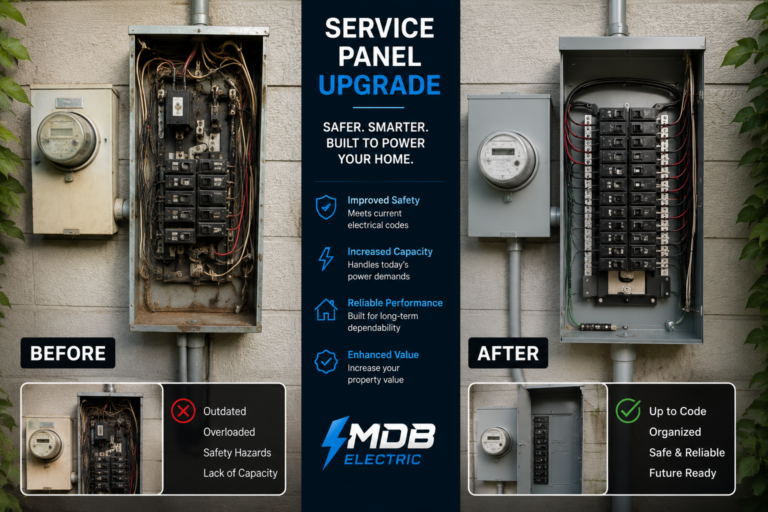
Your electrical panel — sometimes called the breaker box or service panel — is the hub that takes power from the utility and distributes it safely to every circuit in your home. When it’s modern and correctly sized, you never think about it. When it’s outdated or overloaded, it can quietly become a problem. MDBC Electric handles panel work throughout Ventura and Santa Barbara counties (CSLB #1158234).
What Your Panel Does
Power comes into the panel from the grid and is split into individual circuits, each protected by a breaker. If a circuit draws too much current or faults, its breaker trips and cuts the power — that is what prevents overheating. The panel’s amperage rating (commonly 100A, 200A, or 400A) sets how much total power your home can safely use at once.
The main breaker is your whole-house shutoff. Branch breakers protect lighting, outlets, kitchen appliances, HVAC, and other loads. A well-labeled panel makes troubleshooting faster and keeps future work safer. If you are weighing a jump from 100A to 200A, see our guide: Do I need a 200A service?
Signs You May Need an Upgrade
- Breakers that trip often, or an old fuse box instead of breakers
- A 60A or 100A panel in a home adding an EV charger, A/C, hot tub, or an addition
- Flickering lights, a warm panel, or a buzzing sound
- Reliance on power strips because you’re short on circuits
- A recalled or unsafe brand such as Zinsco or Federal Pacific
None of these automatically means “replace it tomorrow,” but they are good reasons to have a licensed electrician look at the panel and do a proper load calculation rather than guessing from photos.
Older and recalled equipment
Some older brands have documented failure modes. Zinsco and Federal Pacific (FPE) panels show up in mid-century homes around Ventura and Santa Barbara counties. A fuse box is another common find. Replacement is usually the practical path: parts are scarce, and modern breakers, grounding, and space for new circuits are what today’s homes need. We confirm the brand on site before recommending anything.
How the Upgrade Works
A panel upgrade usually follows the same path: an on-site assessment and load calculation, a permit pulled with the local building department, a scheduled power shut-off (coordinated with the utility when needed), removal of the old panel, installation and labeling of the new one, and a final inspection. Most residential upgrades are completed in a single day, with power restored the same afternoon.
If the service size is changing (for example 100A to 200A), the utility may need to update the meter or service drop. That coordination is part of the job, not something we leave on you. Details on permits and inspections are in Permits & inspections in Ventura and Santa Barbara counties.
Permits & Inspection
Panel work requires a permit and a city or county inspection — that’s what protects you and keeps your homeowner’s insurance valid. MDBC Electric handles the permits, the utility coordination, and the inspection so you don’t have to. Work is done under CSLB #1158234.
100-amp vs. 200-amp (and when bigger is the point)
Many homes built in the mid-20th century still have 100A (or smaller) service. That can be enough for a modest house with gas heat and no EV. It often is not enough once you add a heat pump, tankless water heater, hot tub, workshop, ADU, or Level 2 charger. 200A is the common residential upgrade in this area because it leaves room for those loads without stacking subpanels as a workaround.
We do not quote a number over the phone from a photo of the deadfront. Capacity is about connected load and how circuits are used, not just the sticker on the door. For a fuller walkthrough, read Do I need a 200A service?
Subpanels, main panels, and where new circuits land
A main panel is where the utility service lands. A subpanel is a downstream box fed from the main — useful in a garage, ADU, or addition when the main is full or far from the new work. A subpanel does not increase the service size; it only redistributes what the main already has. If the main is already at capacity, a subpanel alone will not solve an EV charger or HVAC add.
New circuits for chargers, kitchens, and rewires often start with whether the main has spare breaker spaces and spare amperage. Related work: electrical panel upgrades, EV charger installation, and home rewiring.
What we look at on a site visit
- Service size, main breaker, available spaces, and bus rating
- Grounding and bonding, including water pipe and rod/Ufer connections where they apply
- Condition of lugs, rust, heat marks, double-tapped breakers, and unlabeled circuits
- Clear working space in front of the panel (code requires unobstructed access)
- Planned loads: EV, HVAC, kitchen, ADU, solar-ready space if you mention it
If wiring in the walls is cloth, knob-and-tube, or ungrounded, the panel is only part of the story. See Home rewiring 101 and home electrical safety.
What a typical day of work looks like
You will have a scheduled outage. We confirm the plan, isolate the service, swap the equipment, land circuits on new breakers, label the directory, and restore power the same day in most residential jobs. Inspection is usually a separate appointment after we call it in. You do not need to empty the house; you do need a clear path to the panel and a decision-maker available if the inspector or utility needs access later.
Thinking about a panel upgrade? Call (805) 627-4697 or email permits & inspections.
How long will the power be off?
Most residential panel swaps are a same-day outage measured in hours, not days. If the utility has to set a new meter or change the service drop, their schedule can add wait time before or after our work.
Can you just add a few breakers instead of replacing the panel?
Sometimes, if there is spare space and spare capacity. If the bus is full, the service is undersized, or the equipment is a problem brand, adding breakers is not a durable fix.
Will this affect my insurance or a home sale?
Insurers and buyers often ask about fuse boxes, recalled panels, and unpermitted work. A permitted, inspected upgrade is the clean record. We do not speak for any particular carrier; ask yours if they have a list of panel types they will not write.
Do you work on commercial panels too?
We do commercial and residential work in our service area. Scope still starts with a site visit. Service page: Electrical panel upgrades.