
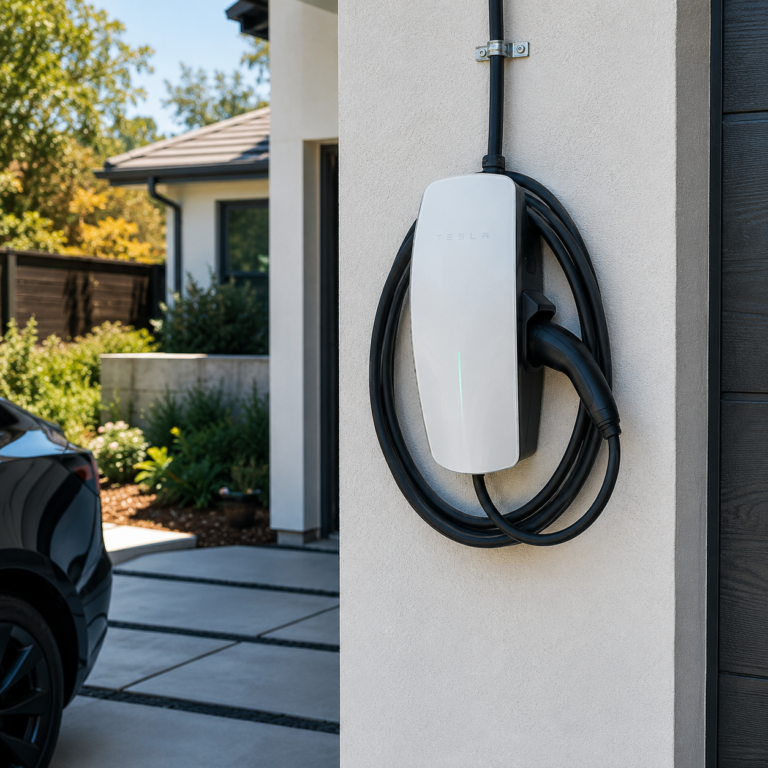
Charging at home is the biggest convenience of owning an electric vehicle — but not every charger or every home is the same. Here’s what to understand before you buy. MDBC Electric installs Level 2 charging in Ventura and Santa Barbara counties (CSLB #1158234).
Level 1 vs. Level 2
Level 1 uses a standard 120V household outlet and adds roughly 3–5 miles of range per hour — fine for plug-in hybrids or very short commutes. Level 2 uses a 240V circuit (like a dryer or range) and adds about 20–40+ miles per hour, fully charging most EVs overnight. Level 2 is what the vast majority of homeowners want.
Public DC fast charging is a different category (typically 400V+ and not a typical home install). Home work is almost always Level 2 on a dedicated 240V circuit.
What Your Home Needs
- A dedicated 240V circuit sized to the charger (commonly 40–60A)
- Enough spare capacity in your electrical panel — older or smaller panels may need an upgrade first
- A good location: garage wall, carport, or driveway within reach of your parking spot
If the panel is 100A and already carrying HVAC and a kitchen, we may recommend a service upgrade before the charger. That is not upselling; it is how load calculations work. See electrical panels explained and Do I need a 200A service?
The Installation Process
We start by checking your panel’s capacity and the best route for the new circuit. From there we run the dedicated 240V line, install either a hardwired charger or a NEMA 14-50 outlet, mount and test the unit, and pull the permit and inspection. Most installs are a few hours; if a panel upgrade is needed first, we’ll fold that in.
Cities and counties in our area generally treat a new 240V EV circuit as permitted work. We handle that paperwork. Overview: permits & inspections. Service page: EV charger installation.
Choosing a Charger
Match the charger’s amperage to what your car can actually accept — paying for a 48A charger does nothing if your vehicle tops out at 32A. Hardwired units are cleaner and often required outdoors; plug-in units are easy to take with you. Smart chargers add scheduling, app control, and energy tracking. Not sure which fits? We’ll help you decide.
Bring the vehicle’s onboard-charger rating (in kW or amps) if you have it. We can also work from the make and model. We install common residential brands; we do not lock you into one manufacturer.
Hardwired vs. NEMA 14-50
A NEMA 14-50 receptacle is the same family of plug many ranges and RV parks use. It is useful if you want to unplug the charger and take it, or if you are between vehicles. Hardwired EVSEs skip the receptacle, which some manufacturers and inspectors prefer outdoors because there is no outdoor receptacle to weather. Code and the unit’s listing drive the choice more than preference.
Either way, it is a dedicated circuit — not a shared dryer outlet with an adapter. Sharing a dryer circuit is not how we install charging.
Where to put it (garage, carport, driveway)
Indoor garage walls are the simplest: short cable run, indoor-rated equipment, easy inspection. Carports and driveways need weather-rated hardware, a mounting plan (wall, pedestal, or post), and a cable path that does not create a trip hazard. HOA rules may limit visible pedestals; we can talk through a clean wall mount if that is the constraint.
Distance from the panel matters. A long run across a finished house is doable but is more wall fishing and more material than a charger on the same wall as the panel. We price the path we actually see on site.
Load calculation, load management, and panel upgrades
The National Electrical Code requires a load calculation (or an approved energy-management method) before adding a large continuous load like an EVSE. If the existing service cannot take the extra amps, options are:
- Upgrade the service (often to 200A) — see panel upgrades
- Use a charger or meter that automatically shares capacity with other loads (load management), where listed and allowed
- Size the circuit to a lower amperage the service can actually support
We will tell you which of those fits your panel rather than assuming every house needs 200A first.
Rebates and utility programs (check current rules)
Utilities and air districts in California sometimes offer rebates or special rates for home charging. Those programs change. We can point you at the current Southern California Edison or other utility pages that apply to your address; we do not invent dollar amounts or guarantee a rebate. Permit fees are set by the city or county, not by us.
Two cars, ADUs, and future-proofing
Two Level 2 chargers is a bigger conversation than one. Sometimes that is two circuits; sometimes it is a shared load-managed setup. An ADU with its own parking can need a subpanel or a second service discussion. If you are already opening the wall or upgrading the panel, it can make sense to leave a spare homerun or extra capacity — we will say so when it is actually useful, not as a default add-on.
Related: electrical safety (GFCI/GFPE requirements on EV circuits have tightened in recent code cycles) and rewiring if the garage still has ungrounded or undersized wiring.
Ready to charge at home? Call (805) 627-4697 or email permits & inspections.
Can you install a charger I already bought?
Usually yes, if it is listed equipment and the circuit can be sized to it. Send the model number before we schedule so we are not guessing at amperage or indoor/outdoor rating.
Will a 14-50 in the garage charge any EV?
Most vehicles that ship with a 240V portable charger can use a properly installed 14-50. Charge rate still depends on the car. A hardwired wall unit is a different product; we will match the circuit to whichever you choose.
What if my panel is full?
Then the honest path is a panel or service upgrade, a load-managed charger, or a smaller circuit — not a tandem breaker squeezed into an overloaded bus. Start with electrical panels.